
Snow on the Tarmac: The Diary of a Travel Nightmare
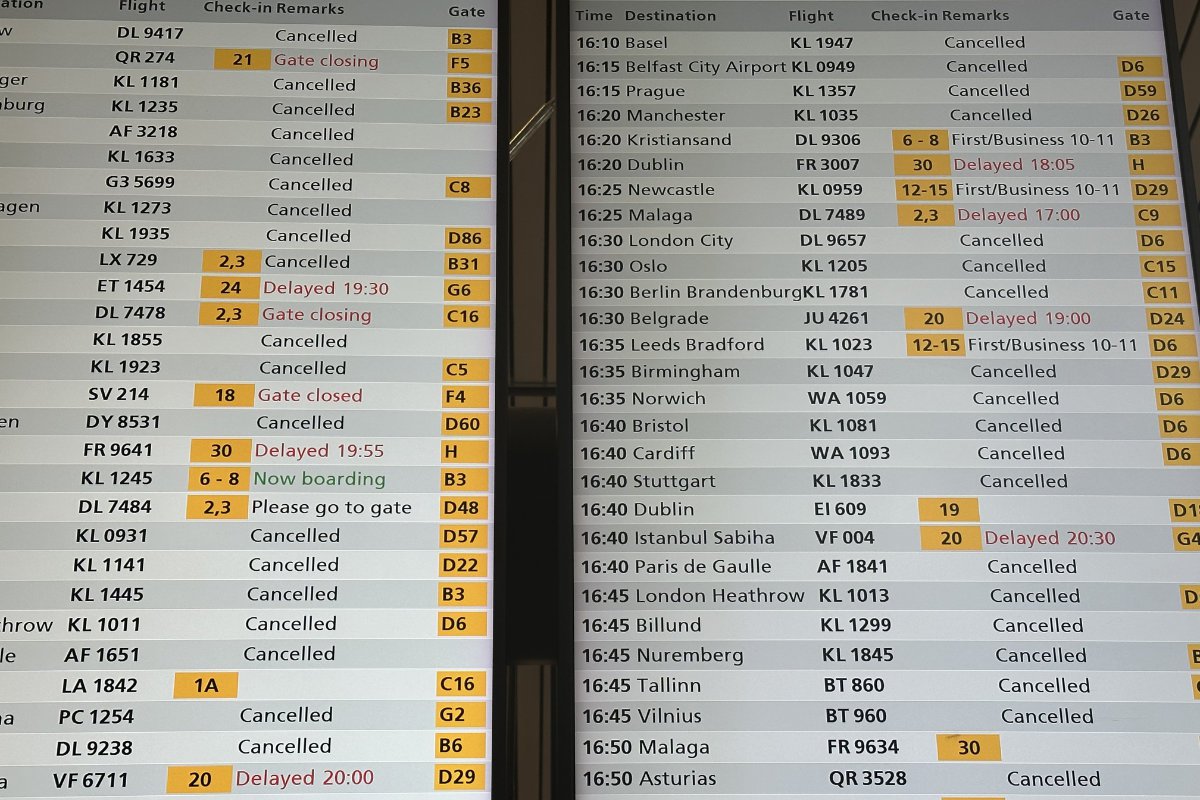 What you do not want to see at the airport. Photo by Jessica Cantlin.
Travel, as we know, isn't always smooth sailing. Contributing editor and experienced traveler Jessica Cantlin recounts her five-day debacle trying to get back home from vacation.
Saturday, January 3, 2026, 4:00 a.m.: After a week spent skiing in the Italian Alps, my 15-year-old daughter and I arrive at Milan’s Linate airport and check our luggage for our 6:00 a.m. flight to Seattle via Amsterdam on KLM.
5:00 a.m.: We arrive to the gate and are informed that, because Amsterdam had a few inches of snow, our departure would be delayed. We had a four-hour layover in Amsterdam, so I was not concerned about making our connection. A few minutes later, the gate agent announces we will board the plane so that, if given a window to take off, we will be ready. We sit on the plane for over an hour and take off earlier than expected, landing in Amsterdam’s Schiphol Airport at noon. I had been receiving messages that our plane to Seattle was delayed, so I am hopeful that we will make our connection. We deplane and race to the gate, only to find it empty – the flight had already boarded and was delayed on the tarmac. Catastrophe will soon unfold around us.
12:00 p.m.: Though it has stopped snowing and there is no snow on the ground, the airport is paralyzed. Schiphol has a limited number of de-icing machines, which leads to delays and cancellations throughout the airport. Lines begin to form, hundreds of people deep. There is yelling, massive frustration, and no answers. The few support agents in the terminal tell passengers not to stand in line but to wait for a text message with rebooking information from the airline.
12:45 p.m.: I receive a message rebooking us on KLM to Seattle via Austin, leaving at 1:30 p.m. This is just the beginning of our nightmare.
12:50 p.m.: We arrive at the gate. KLM announces that the flight to Austin is delayed. At this point, I know that we will not make the connecting flight to Seattle, but the bigger issue will turn out to be getting out of Europe at all.
1:50 p.m.: The gate agent announces a gate change and a new 4:30 p.m. departure time.
4:00 p.m.: The plane taxies into the gate, and the pilot and crew arrive. Everyone is anxiously awaiting to board. The skies are clear, and there is no snow on the ground.
4:30 p.m.: The gate agent announces that the flight is cancelled because of a mechanical problem with the plane, and that we should wait for a message from the airline with rebooking instructions.
6:00 p.m. Since it is late in the day, we leave the airport and go to Pulitzer Amsterdam hotel. We have no luggage (it’s still at the airport), only the clothes on our back (and our ski boots and helmets!). The shops are closing, but we manage to scoop up a few items to keep us clean and warm, as it is threatening to snow again. I call American Express, who had booked our Delta tickets, but the agent is unable to do anything for us because KLM (the partner airline) had taken control of our reservations.
9 p.m.: We go to bed with no idea when we will get a flight out.
Sunday, January 4, 8:00 a.m.: We still have not been rebooked. I leave my daughter and go to the airport. Schiphol is total chaos. Customer service lines snake through the airport. Agents are unequipped to handle the volume of people. I overhear one woman say, “this is my opportunity to behave like an obnoxious American.” (Word to the wise, it is moments like these that call for patience and kindness.) I stand and listen to questionable advice and vague explanations as I try to figure out what our next move should be. Agents are passing out cards with information about passengers' rights and instructions for reimbursement for costs associated with the delays. The agents are telling passengers it could be days before the airport is under control. They request patience. I leave.
11:00 a.m.: Back at the hotel, I call KLM. I am on hold three separate times for two hours each call. The first two calls disconnect shortly after I am connected to an agent. When the third call goes through, I tell the agent to call me back if the line drops Sure enough, the call ends abruptly – but he calls me back!
Travel Lesson I Didn’t Know #1: There is a two-hour rule wherein the call automatically disconnects after two hours.
5:00 p.m. The agent books us on a direct flight to Vancouver the following morning, which, since we’re keeping track, would be day three of the journey.
Monday, January 5, 8:00 a.m. We wake up to snow.
9:30 a.m.: I receive a text message that our flight to Vancouver is cancelled because of a technical problem.
10:30 a.m.: I received a text message rebooking us on a Delta flight to Atlanta at 1:00 p.m. We pack our bags, check out, and race to the airport, only to find the flight delayed.
4:00 p.m.: The gate agent notifies passengers that because our crew would time out, they are rerouting the flight through Boston (and onto Atlanta) to pick up a new crew. Not exactly a direct route to Seattle.
Travel Lesson I Didn’t Know #2: Crews “time out.” A flight crew can work a maximum of 14 hours per shift. For long-haul flights, once a crew is assigned to a flight, if that flight is delayed and the crew cannot fly the distance in under 14 hours, the plane cannot take off and the flight is cancelled.
4:30 p.m.: The pilot and crew arrive to cheering passengers. They do not make eye contact, and I only later realized it was probably because they knew the flight would never take off. Still, ever hopeful, we board the plane.
5:40 p.m.: The pilot announces that we are third in line to be de-iced, a process that will take 45 minutes. He adds that by the time that happens, the crew’s time would have expired. You can imagine where this is going.
6:00 p.m.: The flight is cancelled and we deplane. We returned to the Pulitzer. We still don’t have our luggage — have I mentioned this again?
10:00 p.m.: I receive an email from Delta apologizing that the flight had been cancelled due to “mechanical” issues.
Tuesday, January 6, 7:00 a.m.: We wake up to no new information. I spend the morning talking to a doctor to refill my prescription medication and helping my daughter work through her missed school situation.
2:00 p.m.: A fellow stranded passenger and I decide to go to the airport to see if we can get our luggage: She had heard the airport had started releasing bags. We get to Schiphol only to learn that luggage would not be released unless its destination was Amsterdam. Walking through the empty check-in area of the airport (no one was flying that day because of the snow), I walk up to the most senior-looking ticketing agent to see if she can help us or provide any information. She books us on a direct flight to Seattle the following day, Wednesday, and also on Saturday as backup. The agent then investigates my new friend’s cancelled flight, scheduled for that day, only to tell us that the flight does not exist because it was a ghost flight.
Travel Lesson I Didn’t Know #3: "Ghost flights” are scheduled by the airline to distract displaced passengers. There is no expectation that this flight will ever actually take off, because there is no plane, there is no crew, and there is no gate.
4:00 p.m.: We leave the airport in disbelief.
10:00 p.m.: As I get ready for bed, I receive a message that our Wednesday flight is cancelled. As this point, I am not surprised.
Wednesday, January 7, 7:30 a.m: We wake up to a true snow day. I watch the weather closely and decide that Thursday would be our best bet for getting out, as more snow was on its way Friday.
Thursday, January 8, 9:00 a.m.: We arrive at the airport to massive lines. KLM is a disaster because the power is out at the check-in counters. (Yes, at this point, I am asking myself if I am an extra in a travel nightmare farce.) Thinking fast, I download the KLM app, check in online, and head to security. We are told our luggage will catch up with us, but at this point, I no longer care.
1:00 p.m.: We board the plane with our fingers crossed. The flight is delayed because of the power outage but and eventually we take off – with the plane half empty and an airport full of stranded passengers.
10:00 p.m. CEST; 3:00 p.m. PST: We landed in Seattle nine hours later. I want to cry.
This was not an extended vacation. It was five days of complete stress. I am thankful that I had the resources to be comfortable during this time. I am especially grateful for the kindness shown by the staff at Pulitzer Amsterdam, who knew me by name after day one. I can’t recommend this hotel enough! I am a very resourceful traveler, but not everyone is like me. I could not stop thinking about the hundreds of people sleeping on the floor of the airport and eating at terrible airport food, or those with small tired, screaming children trying to navigate the system. I also felt sorry for the KLM customer service agents, who were ill equipped and unprepared for the barrage of angry passengers – it wasn’t their fault.
Our bill for those extra five days in Amsterdam ran up to thousands of dollars. Insurance coverage through American Express refunded us a whopping $500. I will not be compensated for the hassle or the wasted time because weather is not a covered cause.
So, I wait for reimbursement and rely on the two emails from KLM CEO Marjan Rintel apologizing for the problems and assuring passengers that costs affiliated with the breakdown of the airline would be reimbursed.
Thursday, March 26: I am still waiting to be reimbursed.
Travel Lesson I Should Have Known #1: Buy supplemental travel insurance.