
From Factories to Five Stars, Berlin's Hotels Love a Bold Revolution
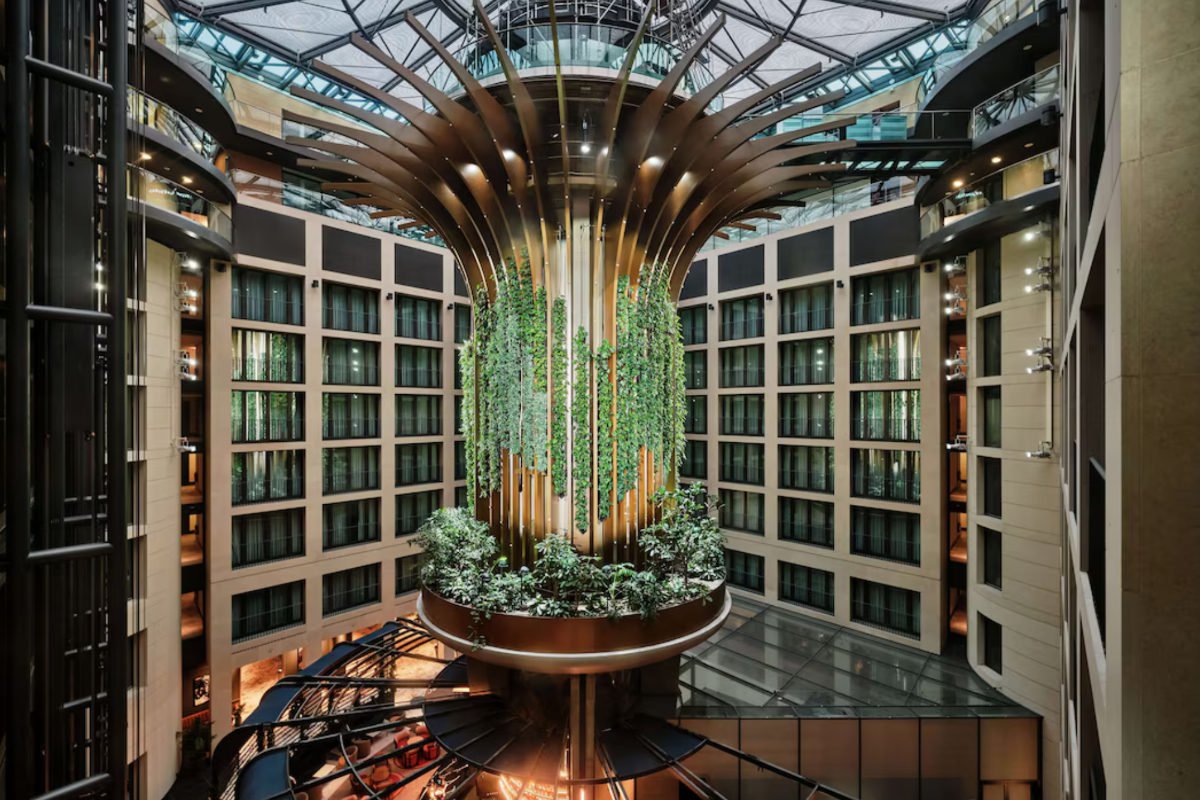 The dome, reborn. Photo courtesy of Radisson Collection Hotel, Berlin.
Ongoing hotel conversions represent Berlin's continued fascination with repurposing historic spaces and turning sites of restriction into destinations of experience and exploration.
BERLIN — Converting historic buildings into hotels — "adaptive reuse," in industry parlance — became trendy in the late 1990s when European developers began converting historic and industrial spaces into hotels. Berlin has excelled as a pioneer of architectural resurrection, turning forgotten industrial spaces, historic buildings, and even former prisons into stunning hospitality experiences. The city — with its complex history of division, reconstruction, and reinvention — has perfected the art of transformative design.
Where other cities demolish, Berlin reimagines. Abandoned swimming halls become boutique hotels, old garages morph into modern accommodations, and former detention centers are reborn as chic retreats. These spaces don't just offer a place to sleep; they tell stories. Each repurposed building becomes a living museum, preserving Berlin's layered narrative while creating something entirely new. It’s a testament to the city's ability to continually and creatively reinvent itself.
A former city resident, I recently returned to investigate the trend and loved what I found.
Hotel Oderberger
Originally a municipal public bathhouse constructed in 1902, this neo-Renaissance building in East Berlin’s hipster Prenzlauer Berg served the community as a public bathing facility for decades. Designed by city architect Ludwig Hoffmann, the bathhouse provided essential hygiene services to working-class residents during the industrial era with bathtubs, showers, and free swims. After falling into disuse in the DDR era, the building sat abandoned after Reunification, until its transformation into a hotel in 2016.
Now fully restored, the original 20-meter swimming pool remains the hotel's centerpiece, surrounded by soaring ceilings and reclaimed tile work. It's a magical space, especially when doused in pink lighting. It's extra special for Christmas swims and private pool parties at night. During the conversion into a hotel with 70 rooms and two apartments, the architects maintained the building's historic character by, for example, preserving 100 doors used for the shower and bath tub cabins. Modern amenities include a gym, a subterranean sauna with infrared beds, and a three-floor breakfast room in the former thermal power station. My go-to place in Berlin to drink tea is the 1920s first floor seating area, and I love to swim in the pool. But to sleep here in a giant industrial room, set along oversized municipal corridors, looking onto snowy Prenzlauer Berg, felt like a stroll through history. There is a modern, high-ceilinged library for reading in the afternoon, and a cozy bar with leather armchairs to sit by the fire at night.
Orania.Berlin
This vintage corner building on edgy Oranienstrasse in Berlin Kreuzberg opened in 1912. In its early days, Cafe Oranienpalast on the ground floor hosted cabarets and concerts and artists slept upstairs. The distinctive structure, representative of early 20th-century German commercial architecture, has housed many significant tenants, including the Central Association of Employees and, until 1956, the C&A department store.
Since reopening as a hotel, jazz bar, and gourmet restaurant in 2017, the 41-room hotel has returned to its roots. The reimagined rooms have handcrafted retro furnishings and handmade Schramm beds. High ceilings and soft decorative colors lend an historic feel. I felt so at home in my 45-square-meter suite with sky-high ceilings and windows and furnishings from B&B Italia and Lambert. A free jazz concert at night and an all-you-can-eat brunch served until 2 p.m. including grilled vegetables, chia bowls, shakshuka, and an English breakfast (I had all of it) were reasons not to leave, not to mention the warm welcome from the couple who run the Orania, Claridge’s alumni and hotel manager Jennifer Vogel and her husband, Michelin-starred chef Phillip Vogel.

Das Stue
Formerly the Royal Danish Embassy in the embassy-rich Tiergarten district, this building was designed in the 1930s as a diplomatic residence during a complex period of European history. Located adjacent to the Berlin Zoo, SO/Berlin Das Stue now blends its1930s neoclassical exterior with a modern interior where original architectural elements like high ceilings and intricate moldings are complemented by contemporary design and the occasional animal reference. If you want to feel like an ambassador, this is the place to stay.
Hotel Telegraphenamt
Historic Telegraphenamt in the Mitte district is a neo-Renaissance 1870s building that once served as the central telegraph office of the German Empire and is now the hipster luxury Telegraph Hotel Berlin. Many original architectural elements remain, like the ornate stonework on the grand façade, restored high ceilings, elegant staircases, and original fixtures. Guest rooms reference the building's communications history through subtle design elements. The former technical areas and office spaces have been converted into a restaurant, bar, and wellness facilities.
Radisson Collection Hotel, Berlin
Originally constructed in 2004, Radisson SAS was known for its spectacular AquaDom — once the world's largest cylindrical aquarium. After the AquaDom's unfortunate collapse in 2022, killing 1500 fish, the hotel underwent extensive renovation and rebranding. While not adaptive reuse in the traditional sense, the hotel's architectural transformation is another instance of Berlin's ability to recover and transform after setbacks. The hotel's most distinctive feature is a soaring glass atrium where the AquaDom once stood, now reimagined as an elegant lobby space with contemporary art installations.

Wilmina
Originally a women's prison and courthouse in Berlin's Charlottenberg from the late 19th century through the mid-20th century, the building witnessed significant historical moments, including periods of political imprisonment during the Weimar Republic and Nazi era.
Transformed into a sophisticated hotel in 2022 over a period of 13 years by an architect couple who added a restaurant, bakery, cafe, bar, and apartments, the space offers a nuanced approach to adaptive reuse. Owners Grunting Ernst Architects preserved significant historical elements while creating a space of reflection and beauty, including several secluded gardens. Seventy cell blocks were transformed into 44 rooms, with many knocked through to create larger spaces. Ambient lighting, soft carpeting, clean brick walls, and leafy plants have softened the feel of the prison, though heavy doors and railings are among the preserved elements reminiscent of the past. Those heavy clunking doors may sound like a prison, but overall it’s very cozy inside. A large living room occupies what was once the intake room, and the former courthouse is used for events and artists in residence. Cake and coffee are served every afternoon in an adjacent kitchen, and free tea, water, and fruit are available all day. The dining room that serves a healthy breakfast overlooks one of the outdoor areas previously used by inmates for exercise.
The Knast
Dr. Joachim Köhrich converted another former women’s prison in West Berlin’s posh, villa-filled Lichterfelde district into The Knast (German slang for prison) and won a Federal Award for Monument Preservation in December 2024. The venue includes a creative gourmet restaurant and a speakeasy that may be Berlin’s best secret bar and cabaret. A strict no-photos policy ensures that hedonism rules here. Regular exhibitions are shown in collaboration with prideArt Berlin eV, and some cells are now art studios for queer artists. A forthcoming boutique hotel will offer nine rooms in former cells and four suites, one with a terrace overlooking the garden, suitable for longer stays under the roof.
The Ameron Berlin Abion Spreebogen Waterside
This four-star hotel in an historic 1890 dairy brilliantly merges industrial heritage with contemporary design, creating a striking contrast between old and new. Located on the River Spree between East and West Berlin near significant Berlin landmarks like the Reichstag, Chancellery, and Tiergarten, the hotel has giant, industrial-style guest rooms with river views, a rooftop gym overlooking the city, eight conference rooms, and two event halls that can accommodate up to 800 people. The hotel is part of the Berlin Spree Bogen development, a transformative urban project along the Spree River that has revitalized an historic industrial area. Located near key government buildings, it integrates modern architecture with preserved heritage structures, creating a dynamic urban landscape that connects Berlin's past and present through innovative design.
Numa Berlin Savi
The imposing Kant-Garagenpalast, Europe’s oldest multi-story parking garage in operation until 2017, shed its utilitarian past to emerge as one of the city's most compelling examples of adaptive reuse. Built in 1929 in the modernist style, this Charlottenburg landmark now houses a vibrant mix of galleries, design studios, and creative workspaces while preserving its distinctive spiral ramps and industrial character. Adjacent to this architectural transformation in a former office space are the Numa Berlin Savi apartments — design-forward accommodations that honor the building's heritage while providing contemporary comforts. Berlin-based digital hotel platform Numa Stays is an excellent, budget choice for travelers, offering digital key access to minimalist apartments available for short- or long-term stays. I had a slick, black-and-white apartment with a full kitchen hidden inside a cupboard and a bathroom and bedroom/living room that made efficient use of such a compact space.
Numa has expanded beyond Berlin, operating digitally-enabled, apartment-style accommodations throughout Europe in Germany (Munich, Hamburg, Frankfurt, and Düsseldorf), Italy (Rome, Florence, Milan, and Venice), Spain (Barcelona, Madrid, and Seville), as well as Vienna, Amsterdam, Prague, Lisbon, and Zurich.